
Forecasting earns its place when it improves a decision. A retailer needs enough inventory for a promotion. A service team needs capacity for next week's arrivals. A plant needs to distinguish an unexpected failure from a planned shutdown. The useful question about a new forecasting model is how well it handles those conditions.
Timestral is a serious new candidate for that work. It supports historical and known future external variables, holiday and vacation features, and learned seasonal patterns. It is a different architecture from Prophet, with different strengths and controls. Replacing Prophet should depend on measured improvements in your process.
This comparison draws on Mistral's launch announcement, the Timestral model card, its released inference code, and Meta's Prophet documentation. Sources were reviewed on 20 October 2026, five days after Timestral's launch. Published scores, calculated limits and synthetic examples are identified separately throughout.1
My starting position is to keep Prophet as an interpretable baseline and test Timestral where related signals, historical drivers and nonlinear dependencies matter. For high frequency data with annual seasonality, examine the history window before choosing either architecture.
Two ways to build a forecast
Prophet fits an explicit model to a target series. Its original formulation combines growth, seasonality and holiday effects. The resulting components give an analyst something concrete to inspect and adjust. The paper describes this as a flexible curve fitting approach, distinct from models that explicitly represent the full temporal dependence structure.4
Timestral starts with pretrained weights and conditions its predictions on the supplied history. Attention operates across time and across variables. Related targets can be forecast together. Its released implementation supports inference without fitting new weights to each dataset.2
| Requirement | Prophet | Timestral |
|---|---|---|
| Getting started | Fit a target model on historical observations | Supply history to a pretrained checkpoint |
| External inputs | Added regressors | Separate historical and known future covariates |
| Calendar events | Dedicated holiday interface and country calendars | Calendar features supplied by your pipeline |
| Seasonal structure | Named components with explicit controls | Patterns learned from history and covariates |
| Several related targets | Separate models; relationships can enter as regressors | Joint target forecasting |
| Explaining a result | Trend, seasonal components and regressor coefficients | No equivalent native decomposition into named business effects |
I would use those differences to frame the evaluation. A powerful predictive model may reduce manual modelling work. An explicit model may make an unusual forecast easier to diagnose. Both advantages have operational value.
External variables, holidays and vacations
Timestral distinguishes past covariates from known future covariates. Historical sensor readings can inform the target without requiring future sensor values. A planned price or production schedule can cover both history and the forecast horizon. Numerical and categorical interfaces are available.3
Prophet's added regressors enter as additive or multiplicative effects. Nonlinear transformations, interactions and lagged effects generally require deliberate feature construction. Its current Python interface also supports a nested Prophet model for an external regressor through regressor_predictor. This capability arrived in v1.4.0, so comparisons that say all future regressors must always be supplied externally are incomplete.5
Holidays are particularly convenient in Prophet: it provides country calendars, custom event dates, event windows and regularisation controls. A business can specify a closure or an event whose date moves each year.6
Timestral receives those facts as covariates. For a retail example I would start with promotion, school_vacation, public_holiday and is_closed. For workforce planning, the fraction of staff scheduled to be on leave may be more useful than a single vacation flag. Feature design should follow the quantity being forecast.
The released Timestral API works with numerical arrays, so dates, sampling intervals and calendar construction remain pipeline responsibilities. Its categorical path target encodes a univariate series; with several target variates it uses the category codes directly. For distinct holiday types, separate binary indicators are a sensible first experiment.3
A calendar flag identifies an event. The model still needs evidence of the effect in this business. A school break can increase visits to one location and reduce them at another. Forecast conditioning alone also does not establish what a price change would cause.
Multiple seasonal cycles need enough history
Prophet supports daily, weekly and yearly patterns, with custom periods through add_seasonality. It also supports conditional seasonalities, such as a different weekly pattern during a school holiday. These components can be regularised and configured as additive or multiplicative.67
Timestral can represent recurring patterns from its context, and its pretraining included synthetic seasonal processes. The released API does not expose a named weekly component or a Fourier order setting. Its support is implicit: accurate recovery of the relevant cycles needs to be checked on the task.1
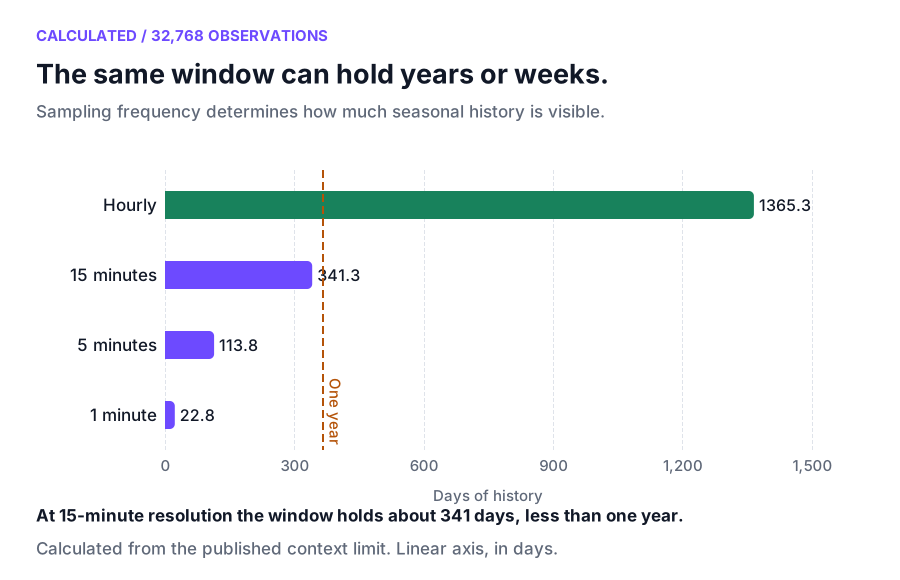
The context limit makes that distinction practical. Timestral accepts up to 32,768 historical steps. Converting that limit into elapsed time gives the following calculated coverage.8
| Sampling interval | History in 32,768 steps |
|---|---|
| Hourly | About 3.7 years |
| 15 minutes | About 341 days |
| 5 minutes | About 114 days |
| 1 minute | About 23 days |
At 15 minute resolution, the context cannot contain a complete annual cycle of target observations. Calendar covariates can identify the time of year; they cannot restore excluded observations. A long context is a capacity limit, and available history may be shorter still.
My engineering options would include a coarser model or a separately estimated long term seasonal baseline, followed by a model for shorter term deviations. Those are designs to validate. Several seasonal periods within one forecast also do not guarantee reconciliation between separately produced hourly, daily and monthly forecasts.
What the reported scores establish
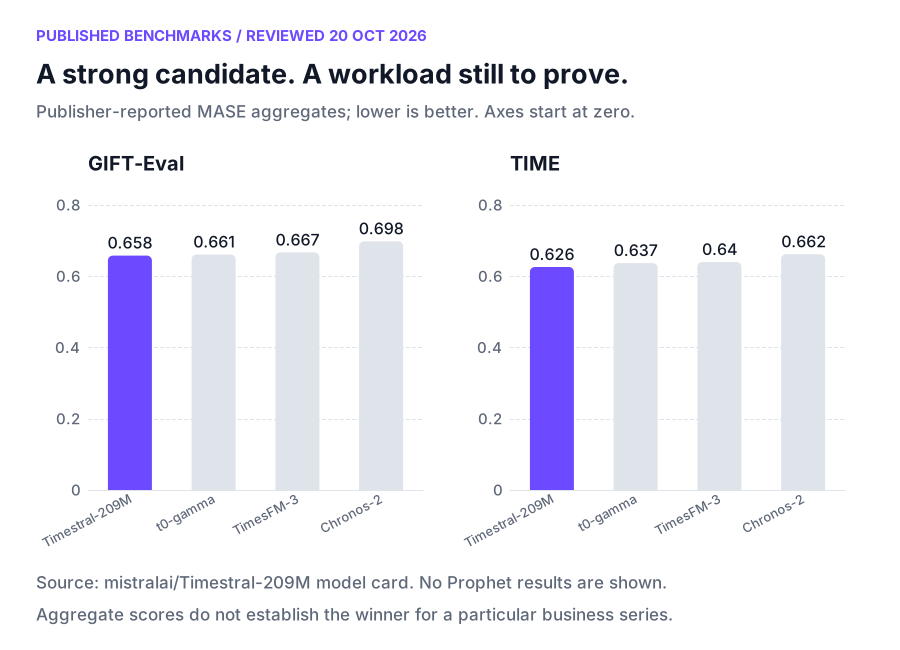
Mistral's model card reports strong aggregate results for Timestral against other foundation models. Figure 2 reproduces two of the reported point forecast metrics. It contains no Prophet result. The values are publisher reported benchmark aggregates, not error percentages or a new experiment conducted for this article.8
| Model | GIFT-Eval MASE | TIME MASE |
|---|---|---|
| Timestral-209M | 0.658 | 0.626 |
| t0-gamma | 0.661 | 0.637 |
| TimesFM-3 | 0.667 | 0.640 |
| Chronos-2 | 0.698 | 0.662 |
At review, the model card still described the full technical report as forthcoming. The released code and weights make local evaluation possible; the headline results provide a reason to run that evaluation.8
Probabilistic output also needs testing. Timestral returns 21 quantiles. Beyond 1,024 forecast steps, it rolls forward in blocks using predicted medians as new context.8 Prophet's default intervals rely on assumptions about future trend changes, and its documentation explicitly cautions against expecting accurate coverage automatically.9 Check interval coverage at the horizon and service level used by the business.
One shared example for both models
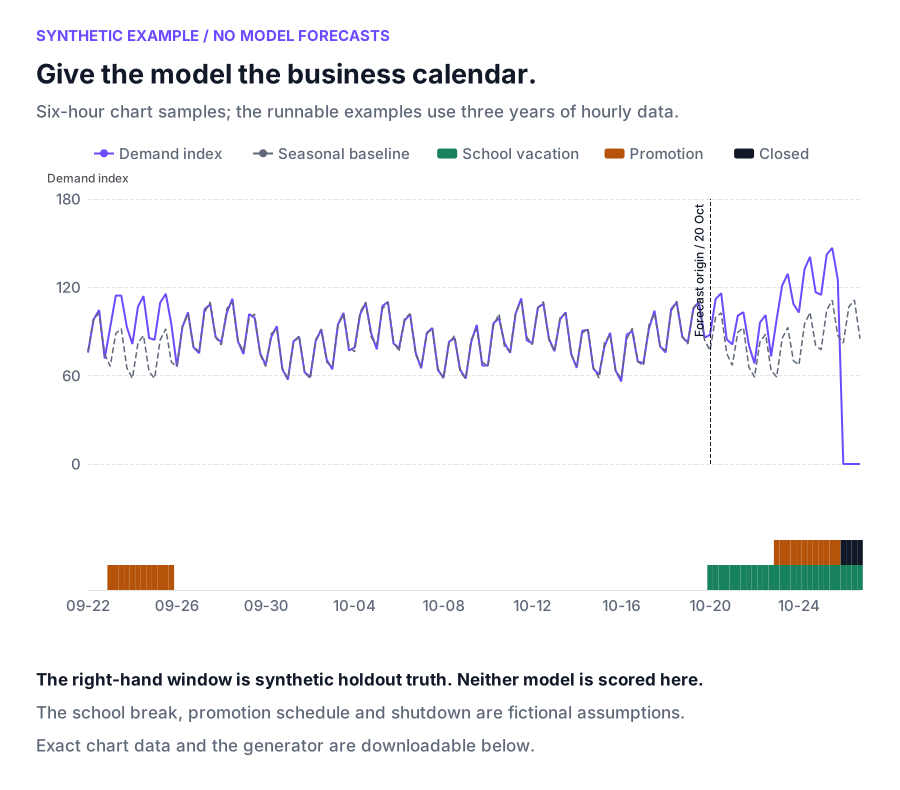
Consider an hourly retail demand index with daily, weekly and annual variation, a recurring promotion, a fictional autumn school break, two public holidays and a planned closure. The generator provides three years of history and a seven day holdout beginning on 20 October 2026.
Figure 3 shows generated reference data, not model predictions. Its future segment is synthetic holdout truth. It explains the inputs and offers a reproducible workflow; it establishes no accuracy ranking. Both model recipes keep future targets out of their prediction inputs.
Download the data generator, Prophet example and Timestral example into one working directory. The generator uses only Python's standard library. Install the model dependencies in separate environments if their requirements differ:
python generate_example.py --output demand.csv

# Prophet environment
python -m pip install pandas "prophet>=1.4.0"
python prophet_example.py

# Timestral environment: Python >=3.10, PyTorch >=2.4
python -m pip install pandas "torch>=2.4" numpy
python -m pip install git+https://github.com/mistralai/timestral.git
python timestral_example.py
Record the actual package versions and checkpoint revision when reproducing results. The first Timestral invocation downloads weights. Its released code supports CPU and GPU inference. A smaller checkpoint, for example mistralai/Timestral-5M, can be selected with the example's TIMESTRAL_MODEL environment variable when checking the workflow.2
Prophet: explicit components and event dates
This recipe fits daily, weekly and annual seasonalities, declares public holidays through the holiday interface, and adds the planned business drivers as regressors. The prediction frame contains dates and drivers only. A known full closure is enforced after prediction as a business rule.
"""Run after generate_example.py; requires pandas and prophet>=1.4.0."""
import pandas as pd
from prophet import Prophet

origin = pd.Timestamp("2026-10-20")
data = pd.read_csv("demand.csv", parse_dates=["ds"])
train = data.loc[data.ds < origin].copy()
future = data.loc[data.ds >= origin].copy()
regressors = ["promotion", "school_vacation", "is_closed"]

# Repeated calendar dates cover the historical and forecast windows.
holidays = data.loc[data.public_holiday.eq(1), ["ds"]].copy()
holidays["ds"] = holidays.ds.dt.normalize()
holidays = holidays.drop_duplicates()
holidays["holiday"] = holidays.ds.dt.strftime("%m-%d").map({
    "01-01": "new_year", "12-25": "christmas",
})
model = Prophet(
    holidays=holidays, yearly_seasonality=10,
    weekly_seasonality=3, daily_seasonality=5,
    interval_width=0.8,
)
for name in regressors:
    model.add_regressor(name)

model.fit(train[["ds", "y", *regressors]])
# No future y is passed to predict.
forecast = model.predict(future[["ds", *regressors]])
result = forecast[["ds", "yhat", "yhat_lower", "yhat_upper"]].copy()
result.columns = ["ds", "prediction", "lower", "upper"]
result[["prediction", "lower", "upper"]] = result[["prediction", "lower", "upper"]].clip(lower=0)
# A known full closure is enforced as an explicit business rule.
result.loc[future.is_closed.to_numpy().astype(bool), ["prediction", "lower", "upper"]] = 0
result.to_csv("prophet_forecast.csv", index=False)
print("Saved prophet_forecast.csv; intervals need coverage validation.")
For a historical variable whose future is unknown, current Prophet can attach a nested predictor using model.add_regressor("driver", regressor_predictor=True) before fitting. Validate that additional prediction stage as part of the full pipeline.5
Timestral: context and known future covariates
The same calendar facts enter Timestral as conditioning rows. Cyclic date features make hour, week and annual position explicit; Prophet receives that date information through its seasonal components. The target has shape (batch, targets, history), while known covariates cover history + horizon. No fitting call is needed.3
"""Run after generate_example.py; requires pandas, torch and timestral.

The first call downloads model weights. TIMESTRAL_MODEL can select a smaller
checkpoint, for example mistralai/Timestral-5M, when testing the workflow.
"""
import os
import numpy as np
import pandas as pd
import torch
from timestral import TimestralForecaster

origin = pd.Timestamp("2026-10-20")
data = pd.read_csv("demand.csv", parse_dates=["ds"])
train = data.loc[data.ds < origin]
future = data.loc[data.ds >= origin]
features = [
    "promotion", "school_vacation", "public_holiday", "is_closed",
    "hour_sin", "hour_cos", "week_sin", "week_cos", "year_sin", "year_cos",
]
# Calendar features are generated from dates and plans, never future y.
context = train.y.to_numpy(dtype=np.float32)[None, None, :]
known = data[features].to_numpy(dtype=np.float32).T[None, :, :]
assert context.shape[-1] <= 32768
assert known.shape[-1] == context.shape[-1] + len(future)
model = TimestralForecaster.from_pretrained(
    os.environ.get("TIMESTRAL_MODEL", "mistralai/Timestral-209M"),
    device="cuda" if torch.cuda.is_available() else "cpu",
)
forecast = model.forecast(
    context, prediction_length=len(future), known_covariates=known,
)

def values(tensor):
    return tensor.detach().cpu().numpy()[0, 0]

result = pd.DataFrame({
    "ds": future.ds.to_numpy(), "prediction": values(forecast.median),
    "lower": values(forecast.quantile(0.1)),
    "upper": values(forecast.quantile(0.9)),
})
result.loc[future.is_closed.to_numpy().astype(bool), ["prediction", "lower", "upper"]] = 0
result.to_csv("timestral_forecast.csv", index=False)
print("Saved timestral_forecast.csv; prediction is the median, not the mean.")
The central prediction is Timestral's median. Prophet's yhat is its point prediction; the quantities should not be treated as interchangeable estimates of the mean. The 10th and 90th percentiles form an 80% nominal interval, whose observed coverage still needs checking. The examples are inference recipes rather than an executed accuracy contest.
Choose against the decision you need to make
I would run seasonal naive, tuned Prophet, Timestral without covariates, and Timestral with covariates across the same rolling forecast cutoffs. Prophet already provides diagnostics for simulated historical forecasts; the same principle applies to every candidate.10
Keep the information boundary consistent. A future price must be the plan available at the forecast origin. Weather must be the forecast available then, rather than later observations. Build categorical encodings inside each cutoff. A useful extra experiment is to remove each external driver and see whether it improves held out performance.
Measure the losses that affect the decision: shortage costs, excess stock, missed capacity or unnecessary alerts. Review holidays and promotions separately from ordinary days. Examine error by horizon and series, interval coverage, compute cost and time spent correcting forecasts. Use several event occurrences where possible; one Christmas is weak evidence of reliable holiday behaviour.
I would start with Prophet when the priority is an explicit, inspectable calendar model. I would make Timestral a leading challenger when related targets and complex dependencies are important. A portfolio can justify different choices for different series.
Maintenance belongs in that decision too. Prophet's repository now identifies it as being in maintenance mode, with fixes and dependency updates but no new features planned. Timestral is newly released.11 Neither status establishes forecast quality. A production choice needs an owner, a repeatable evaluation and a way to detect when the forecast stops serving its purpose.
References and reproduction notes
This article distinguishes source claims from engineering recommendations. Benchmark numbers are copied from the model card into the authored research data. History durations are calculated from the published step limit. The demand example is generated from explicit fictional assumptions. The charts are rendered with Apache ECharts at build time, with downloadable options and data.
The model recipes have not been used here to produce a measured Prophet versus Timestral ranking. A commercial evaluation should pin dependencies, data snapshots and model revisions, then preserve its predictions and actual outcomes.
-
Mistral, Introducing Timestral, 15 October 2026. Launch date, pretraining approach and announced architecture. Reviewed 20 October 2026. ↩↩
-
Mistral, Timestral repository and README. Joint targets, covariate roles, model sizes, inference and deployment interface. Reviewed 20 October 2026. ↩↩
-
Mistral, released Timestral forecasting implementation. Array shapes, categorical preprocessing, input roles and forecast outputs. Reviewed 20 October 2026. ↩↩↩
-
Sean J. Taylor and Benjamin Letham, Forecasting at Scale, 2017. Prophet's original decomposition and analyst workflow. ↩
-
Meta, Prophet Python API and current implementation. Added regressors,
regressor_predictor, coefficient structure and seasonal controls. Reviewed 20 October 2026. ↩↩ -
Meta, Seasonality, Holiday Effects, and Regressors. Holiday calendars, custom events, seasonal components and conditions. Reviewed 20 October 2026. ↩↩
-
Meta, Multiplicative Seasonality. Additive and multiplicative seasonal and regressor effects. ↩
-
Mistral, Timestral-209M model card. Published benchmark aggregates, context, quantiles, forecast rollout and technical report status. Reviewed 20 October 2026. ↩↩↩↩
-
Meta, Uncertainty Intervals. Assumptions behind trend uncertainty and default intervals. ↩
-
Meta, Diagnostics. Rolling historical cutoffs, horizons and performance assessment. ↩
-
Meta, Prophet README. The 2026 maintenance mode notice and release history. Reviewed 20 October 2026. ↩