
Enterprise automation is moving from theory to practice. There are flows and tools we can use today to test how much faster a task can become, how well the result holds up, and where human judgment remains necessary. The next step is to put them to work on the processes that matter to your company.
A customer case needs a resolution. An invoice needs a correctly matched record. A supplier comparison needs evidence that supports a decision. These are useful outcomes against which we can evaluate automation, including the human effort required to complete the work.
My recommendation is straightforward: use AI to judge low-stakes automation. For high-stakes processes, keep subject-matter experts accountable, with AI providing a second opinion. Record what happens, learn from it, and use that evidence to decide where greater delegation makes sense.
Two kinds of automation
I would separate enterprise automation into two categories: flow-based and agentic.
For most recurring cases, we want a repeatable and predictable flow. The organization knows the steps, the branches and the conditions for completion. A routine invoice can move through extraction, matching, duplicate checking and an exception route. AI can interpret the document while code enforces the matching rules and permissions.
Agentic automation is more resourceful when a case is open-ended: a new issue, an unfamiliar discrepancy or a one-of-a-kind solution. The next step depends on what the system discovers. An agent can seek evidence, test alternatives and revise its approach within defined tool, authority, time and spending limits.
| Design choice | Flow-based | Agentic |
|---|---|---|
| Appropriate work | Most recurring cases | New issues and open-ended investigation |
| How it proceeds | Tested steps and explicit branches | Chooses and revises steps as evidence develops |
| Completion | A verified record or completed service | A verified resolution, supported proposal or expert handoff |
| Controls | Validated inputs, permissions and exception routes | Permitted tools, investigation budget and stopping conditions |
Triage connects the two. Familiar cases enter the tested flow. Unfamiliar cases receive investigation when it can add value. Consequential judgment goes to an accountable expert in either route. When an investigation produces a verified solution that recurs, product and business developers can turn it into a reusable flow.
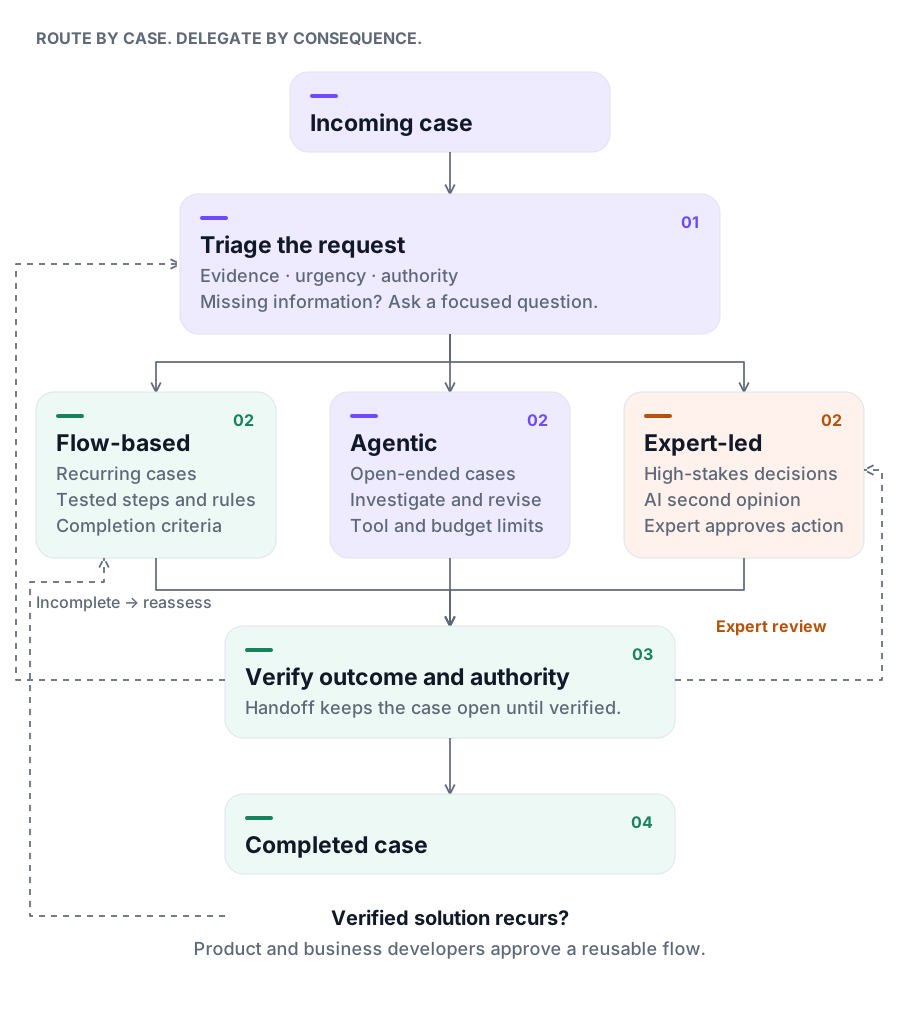
Judge the automation, and learn from the expert
Automation quality needs its own assessment. Did the correct record change? Was the response complete? Did the intended recipient receive it? Did the action happen once, within the authority granted? A fluent answer is only one part of a completed process.
For low-stakes work, AI can assess results against explicit acceptance rules, supported by deterministic checks and human sampling. Test the assessor on company examples: which incorrect results does it accept, which correct results does it reject, and which mistakes does it share with the producing model?
For high-stakes processes, the subject-matter expert remains accountable. AI provides a second opinion: checking the evidence, identifying omissions and offering alternative interpretations. This applies to both automation categories. A predictable flow can still contain a consequential decision.
Never leave the expert operating alone.
Record the AI recommendation, the expert's view, their disagreements, the expert's corrections, the final action and the actual outcome. Include the model, workflow and guardrail versions. Where practical, capture the expert's initial view before showing the AI recommendation. Preserve uncertainty when the outcome is delayed or unresolved.
The correction matters; the later result helps establish whether it was the right correction. Sample agreements too, because the expert and AI can share a mistaken assumption.
That evidence can show which automation chains are predictable enough, with sufficient safeguards, to delegate more judgment to AI. Expand delegation by tested case type and workflow version, and retain a route back to expert review. This is how I would develop the process over time.
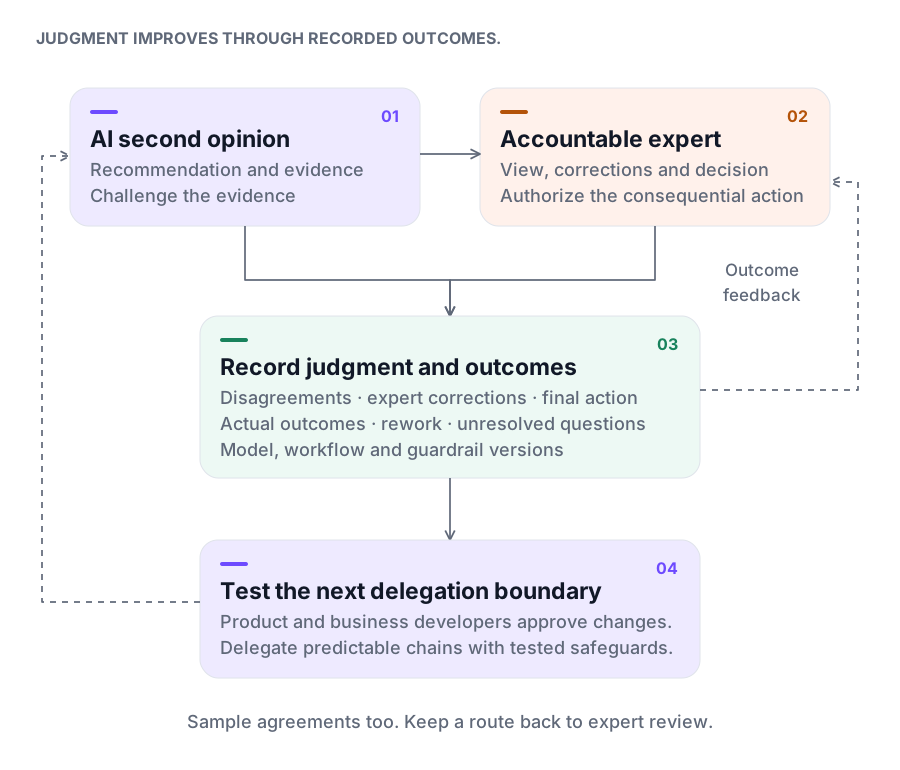
Design the whole service
Triage becomes essential as ticketing and handling grow more complex. Assess the requested action, its consequences, urgency, available evidence and whether it matches a tested route. A brief request to change a supplier's bank account can require more authority than a lengthy request for a status explanation.
Missing information calls for focused clarification. Unfamiliar but investigable work can go to an agent. Urgent cases or conflicting authority need a named human owner. Measure escalation arrivals, handling time and queue age: faster preparation can increase demand on a small expert group.
Phone, messaging, web and apps are entrances to the same service. The entire interaction funnel needs deliberate design: capture the request, establish identity and context, collect evidence, triage, execute or escalate, confirm the outcome, and follow up.
A caller continuing in an app should inherit the same case history. A failed phone transfer needs a recovery route. Repeated messages should not execute an action twice. Test these transitions as part of the service, and measure repeat contacts and cost per resolved case alongside response speed.
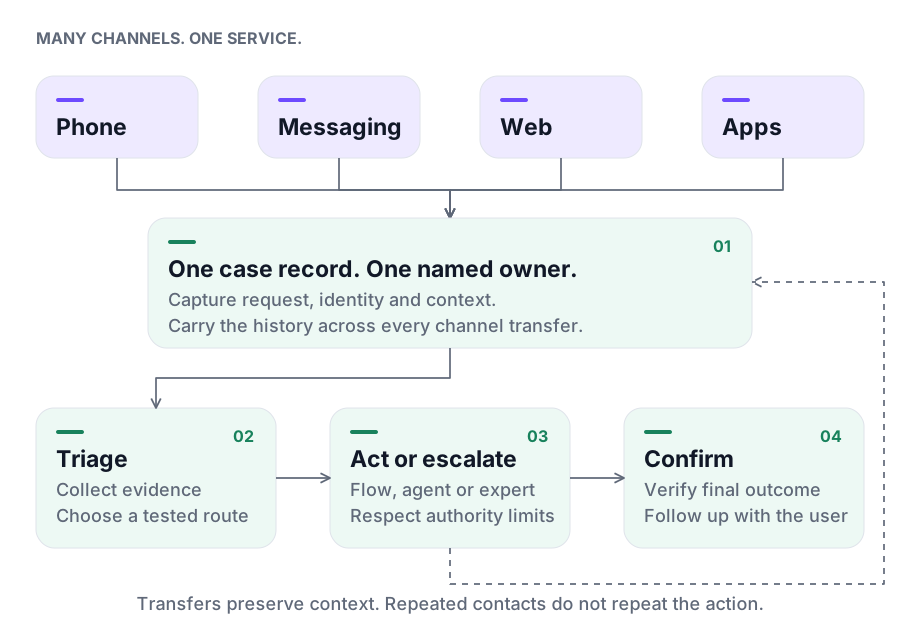
I would leave guardrail design with product and business developers. They define purpose, permitted actions, acceptance criteria, required evidence, escalation routes, stopping conditions and economic limits. Subject-matter experts supply domain criteria and remain accountable for consequential decisions. Engineering implements and tests the controls.
Translate those choices into enforcement where possible: permissions, validated tool inputs, deterministic checks, approval gates and spending limits. Define who owns changes to the rules. Guardrails and the interaction funnel are part of the product being designed.
Validate acceleration in company-specific pilots
Evaluations and tests must be company- and process-specific. Use your documents, languages, ticket categories, procedures, permissions, exception histories and actual outcomes. Generic model scores can help identify a candidate; the pilot establishes whether it works in this process.
Compare representative cases under the current process, an improved deterministic workflow, and the proposed AI-supported design. Define acceptance before running the comparison. Measure active human minutes, elapsed completion time, correctness, unresolved cases, corrections, exceptions, tool spending and downstream losses. Keep the incoming case mix comparable and count retries and work transferred to other teams.
Task acceleration changes jobs. As routine preparation shrinks, exceptions and consequential decisions take a larger share of the retained work. Plan where released time goes, protect expert capacity, and provide the training needed for new responsibilities.
The following examples are illustrative pilot targets, using an assumed fully loaded labor cost of $40 per hour. Remaining time includes initiation, checking, corrections and expected exceptions. These are hypotheses to validate, not measured results.
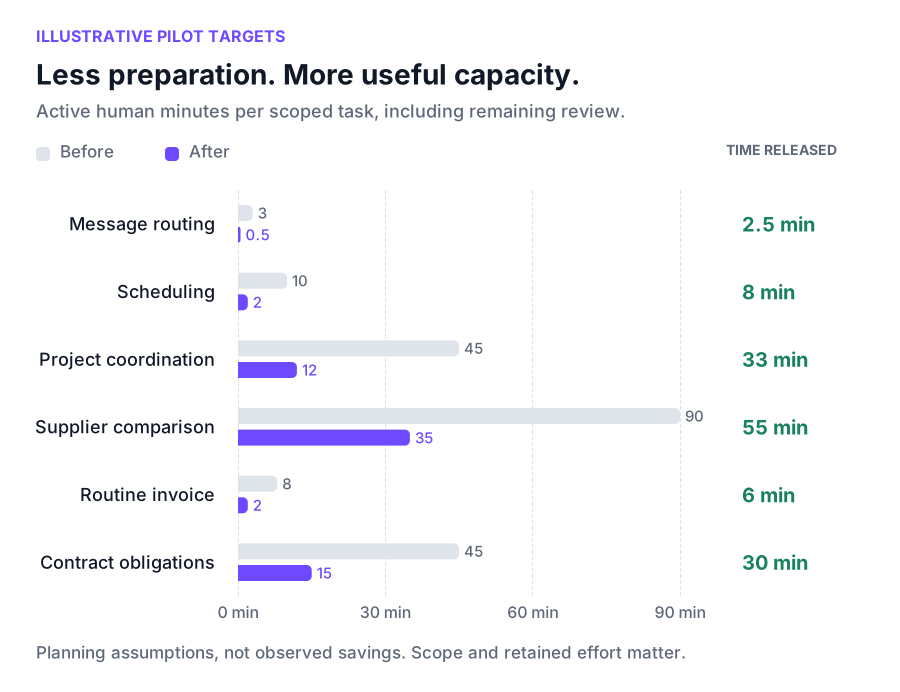
| Scoped task | Human minutes before → after | Potential capacity value |
|---|---|---|
| Classify and route one incoming message | 3 → 0.5 | $1.67 |
| Arrange one meeting with five attendees | 10 → 2 | $5.33 |
| Update 20 tasks and produce a status brief | 45 → 12 | $22.00 |
| Compare five suppliers using retrieved sources | 90 → 35 | $36.67 |
| Extract and match one routine invoice | 8 → 2 | $4.00 |
| Extract obligations from one 20 page contract | 45 → 15 | $20.00 |
Released time needs a use before it becomes enterprise value: avoided overtime, capacity for growth, reduced outsourcing or progress on an existing backlog. Name the mechanism and its owner as part of the pilot.
For an illustrative monthly scenario, 1,000 invoices at 8 minutes each require 133.3 human hours. Reducing active work to 2 minutes releases 100 hours, with a potential capacity value of $4,000.00 per month.
The assumed monthly service allowance is $243.33: $83.33 in amortized setup cost, $100.00 in maintenance, $20.00 for tools, and $40.00 for processing and hosting. The scope assumes reusable access to clean records and excludes additional integration or control work.
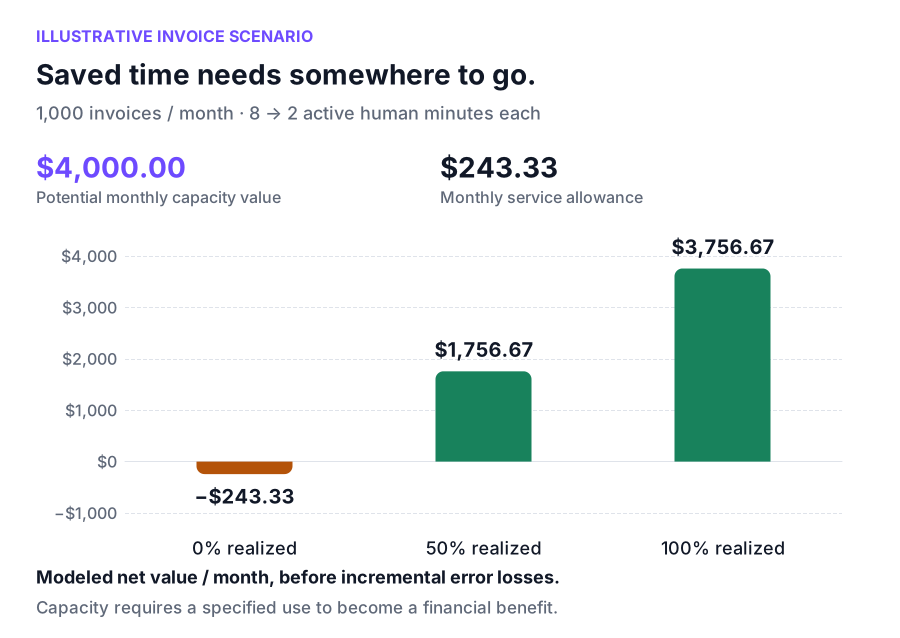
| Capacity realized | Monthly capacity value | Monthly service cost | Modeled net value |
|---|---|---|---|
| 0% | $0.00 | $243.33 | −$243.33 |
| 50% | $2,000.00 | $243.33 | $1,756.67 |
| 100% | $4,000.00 | $243.33 | $3,756.67 |
Include incremental error losses. In this scenario, an additional 1% probability of a $500.00 loss adds $5.00 per invoice in expected loss, compared with $4.00 in gross capacity benefit. This is a sensitivity example. Cash payback needs actual cash flows; the amortized allowance alone does not establish it.
Before expanding, confirm a maintained workflow owner, an affordable support burden, a feasible expert queue and a specific use for the released capacity. Retest after meaningful changes to the model, permissions, tools or procedure.
From theory to practice
We can now use concrete flows and tools to validate task acceleration strategies. Start with a bounded process, evaluate the whole service, and use recorded outcomes to determine where automation and delegated judgment can grow.
I can help define a roadmap and a set of pilots to determine what works best for your enterprise automation strategy. Let's talk.
Appendix: What the evidence supports
Evidence reviewed on 10 October 2026. Evidence window: 10 October 2025–10 October 2026, based on first release. Measurement periods are reported separately.
Recent primary sources address active time released, useful work completed, commercial output and operating costs. These measures have different units and study designs. A controlled reduction in task time establishes released capacity; translating it into additional service or financial return requires further observation.
| Setting | Documented outcome | Method and interpretation |
|---|---|---|
| Clinical documentation: 66 practitioners and 71,487 notes | 21.6 fewer documentation minutes per normalized eight-hour workday; 95% confidence interval: 10.2–33.0 minutes saved | Randomized, 24-week stepped-wedge deployment. Documentation time was a secondary endpoint. Measured August 2024–March 2025; first results published 26 November 2025. Establishes released capacity. Afshar and colleagues. |
| Online retail: millions of users and products | Sales effects from no detectable improvement to +16.3% across seven experiments | Randomized field experiments at one platform. Measured September 2023–June 2024; first released 14 October 2025. The pre-sales chatbot comparison used a baseline without interactive pre-sales support. Fang and colleagues. |
| Enterprise workers: approximately 9,000 respondents across almost 100 organizations | 40–60 minutes saved per active day, reported by users; 75% reported being able to complete tasks they previously could not perform | Vendor survey published 8 December 2025. Self-reported time and capability; causal attribution and financial realization need company measurements. OpenAI enterprise report. |
| Klarna customer service: financial year 2025 | AI handled 80% of service chats; management estimates approximately $59m in 2025 cost savings | Service logs and management attribution, reported 26 February 2026. The accounts are audited; the AI-specific estimate is not a separately audited causal result. 2025 Form 20-F, printed p.183. |
Company outcomes still need observation. Yotzov and colleagues surveyed nearly 6,000 senior executives in four countries during November 2025–January 2026. In their March 2026 working paper, 89% reported no AI effect on sales per employee over the preceding three years. This is executive self-report using a broad definition of AI. It supports connecting task-level improvements to observed company results. Firm Data on AI.
The operational sources support particular design choices:
- Task mapping and delegated judgment: Anthropic's Economic Index: Cadences, 26 June 2026, examines observed AI use and work outputs. Its artifact analysis samples conversations from 10 April to 10 June 2026.
- Flow and agent design: Google Cloud's Graph Workflows in ADK, 29 September 2026, distinguishes predefined paths and open-ended investigation, including deterministic checks and human-review pauses.
- Quality assessment: Anthropic's Demystifying evals for AI agents, 9 January 2026, recommends expert-calibrated graders, inspection of final environment state, and ongoing evaluation maintenance.
- Enforceable boundaries: Anthropic's Beyond permission prompts, 20 October 2025, describes filesystem and network boundaries for coding agents.
- A separate AI assessor: OpenAI's Auto-review of agent actions, 30 April 2026, describes monitored authorization decisions, denial reasons and human fallback for coding agents.
Product and business ownership, the stakes-based delegation recommendation, the feedback loop and the interaction funnel are my design proposals. The numerical targets and service allowances are illustrative. The cited evidence supports the particular measured claims above.
Appendix: Task portfolio
The 26 candidates below form an opportunity inventory. Each timing is a hypothesis at a defined scope, using $40 per active human hour. Capacity value prices released time before operating costs. Remaining time includes initiation, checking, corrections and expected exceptions.
| Task and scope | Minutes before → after | Labor before | Labor after | Capacity value |
|---|---|---|---|---|
| Document control: Classify and file 10 documents | 20 → 5 | $13.33 | $3.33 | $10.00 |
| Master data: Clean and reconcile 50 records | 30 → 8 | $20.00 | $5.33 | $14.67 |
| Accounts payable: Extract and match one routine invoice | 8 → 2 | $5.33 | $1.33 | $4.00 |
| Reporting: Prepare one recurring weekly report | 60 → 15 | $40.00 | $10.00 | $30.00 |
| Sales operations: Update one CRM record from approved notes | 6 → 2 | $4.00 | $1.33 | $2.67 |
| IT service desk: Diagnose one known issue and propose a remedy | 15 → 5 | $10.00 | $3.33 | $6.67 |
| Procurement: Compare three supplier quotations | 45 → 12 | $30.00 | $8.00 | $22.00 |
| Customer service: Prepare one routine customer response | 8 → 3 | $5.33 | $2.00 | $3.33 |
| HR operations: Prepare one standard onboarding pack | 30 → 10 | $20.00 | $6.67 | $13.33 |
| Software QA: Triage one regression run and draft defects | 45 → 15 | $30.00 | $10.00 | $20.00 |
| Message routing: Classify and route one incoming message | 3 → 0.5 | $2.00 | $0.33 | $1.67 |
| Project coordination: Update 20 tasks and produce a status brief | 45 → 12 | $30.00 | $8.00 | $22.00 |
| Scheduling: Arrange one meeting with five attendees | 10 → 2 | $6.67 | $1.33 | $5.33 |
| Creative production: Develop five campaign concepts and copy variants | 60 → 25 | $40.00 | $16.67 | $23.33 |
| Scriptwriting: Draft an 800 word narration and scene plan | 120 → 45 | $80.00 | $30.00 | $50.00 |
| Research analysis: Compare five suppliers using retrieved sources | 90 → 35 | $60.00 | $23.33 | $36.67 |
| Privacy and redaction: Check and redact one 10 page document | 15 → 5 | $10.00 | $3.33 | $6.67 |
| Contract obligations: Extract obligations from one 20 page contract | 45 → 15 | $30.00 | $10.00 | $20.00 |
| Audit evidence: Assemble 10 evidence items for one control | 60 → 20 | $40.00 | $13.33 | $26.67 |
| Software licences: Review usage and allocations for 50 accounts | 30 → 8 | $20.00 | $5.33 | $14.67 |
| Recovery rehearsal: Coordinate one application restore test | 20 → 5 | $13.33 | $3.33 | $10.00 |
| Training coach: Prepare one 10 question practice exercise | 30 → 12 | $20.00 | $8.00 | $12.00 |
| Inventory exceptions: Review one exception batch covering 20 SKUs | 25 → 8 | $16.67 | $5.33 | $11.33 |
| Visual inspection: Review a batch of 20 product images | 20 → 8 | $13.33 | $5.33 | $8.00 |
| Facilities monitoring: Review one daily building exception batch | 20 → 6 | $13.33 | $4.00 | $9.33 |
| Automation supervision: Review records from 20 agent runs | 20 → 5 | $13.33 | $3.33 | $10.00 |
Scope determines the intervention. Recovery rehearsal prices coordination and excludes restore runtime. Training prices exercise preparation and excludes learner time. Visual inspection requires a validated vision workflow. Telemetry, forecasting, recovery infrastructure and media generation need their own operational budgets. For licence reclamation, verified cancellable spend is a separate benefit from review-time compression.
Download the scenario inputs and the generated task portfolio to inspect the scopes, timing assumptions and calculations.